


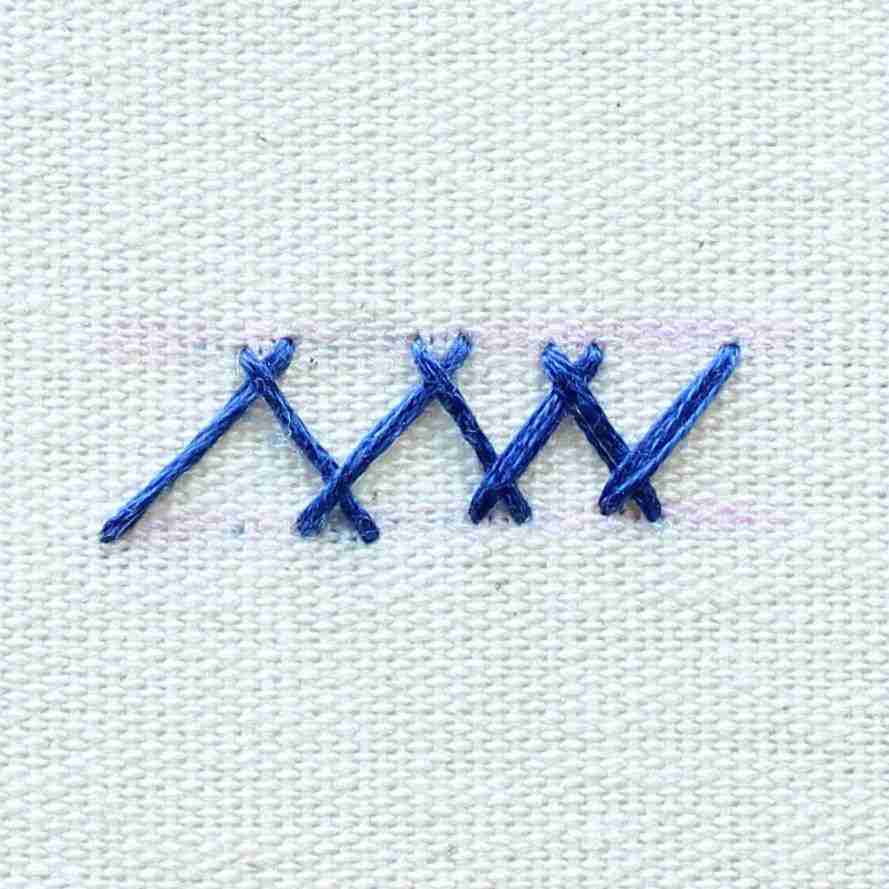
Flannel Stitch
De flanelsteek is a gekruiste basissteek with a open, asymmetrisch ritme. Je uset hem for sierranden, arcering, decoratieve lines and lighte vulling.
⚠ Common mistakes
- Houd de kruisingen gelijkmatig, anders wordt de rand onrustig.
- Trek de draad not te strak aan, want de open structuur hoort zichtbaar te blijven.
- Werk with twee hulplines als you de hoogte gelijk wilt houden.
Definition
Herringbone stitch is an open embroidery stitch in which diagonal stitches cross one another in a regular rhythm. This creates an airy line or band with small X shapes. Unlike a densely filled area, the ground fabric remains clearly visible. The stitch can be worked in a single row, but is also suitable for repeating side by side. The simplicity of the movement makes herringbone stitch versatile for both borders and subtle texture.
When to use it
Use herringbone stitch for an open decorative border, shading in an illustration, a decorative band in a sampler or light filling in a narrow area. It is ideal when you want more structure than a single line stitch but do not need a heavy border. Use contrasting thread when you want the crossings to be visible, or choose a soft shade for a quiet background accent.
Practical tips
For a long band, draw two thin parallel guide lines and use them as the upper and lower boundaries. First embroider a short sequence to determine the desired width. Keep the thread tension even and check every few stitches that all the crossings fall roughly in the centre. A thin thread often looks best on finer fabric; on coarser fabric, you can make the stitch larger for a more distinct pattern.
