


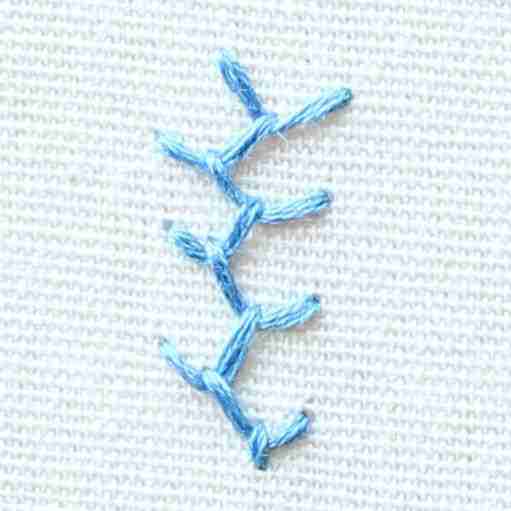
Cretan Stitch
De Cretan Stitch is een open borduursteek waarbij schuine steken elkaar afwisselen tussen twee denkbeeldige lijnen. Door de kleine kruisingen ontstaat een ritmische, decoratieve lijn die losser oogt dan een rechte randsteek.
Hoe maak je deze steek?
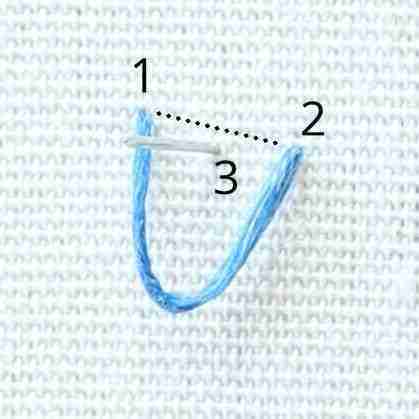 1
Draw or imagine four vertical lines next to one another: A, B, C, D.
 2
Bring the needle up at B. Insert it down at D and up at C — the working thread lies under the needle. Pull through.
 3
Change direction. Insert down at A (slightly lower) and up at B — working thread under the needle. Pull through.
 4
Repeat: alternately to the right (D→C) and left (A→B), moving slightly lower each time. The stitches overlap in the middle.
⚠ Common mistakes
- De twee hulplijnen ongelijk houden, waardoor de steek gaat slingeren.
- Te strak aantrekken, waardoor de open vorm dichtklapt.
- De insteekpunten niet afwisselen; dan verdwijnt het typische Cretan Stitch-ritme.
Definition
Greek stitch is an open embroidery stitch worked between two imaginary or drawn lines. The stitches cross diagonally over one another and are secured each time by the next stitch, creating a rhythmic, braided row. The central space remains partly open. This makes the stitch less solid than a filling stitch, while still clearly decorative. You can make Greek stitch narrow or wide by changing the distance between the two outer lines. Short stitches look refined; longer stitches make the pattern more expressive.
When to use it
Use Greek stitch for leaves, stems, sprigs, decorative bands, border lines and open edges around a shape. It works well in botanical embroidery and samplers, as well as in a modern, graphic border. Because the stitch is flexible, you can guide it around a gentle curve. On a broad leaf, the open central line can even suggest the vein. Choose thread that is sufficiently visible against the ground fabric so that the diagonal crossings remain recognisable.
Practical tips
When practising, draw two faint guide lines and start with a narrow strip. Keep the spacing between the stitches even and place the working thread over or under the previous stitch in the same rhythm each time. Use an embroidery hoop to keep the fabric flat. To make a natural leaf, bring the lines closer together towards the tip and gradually shorten your stitches. Work calmly: Greek stitch looks best when the crossings lie clearly and without tension.
