


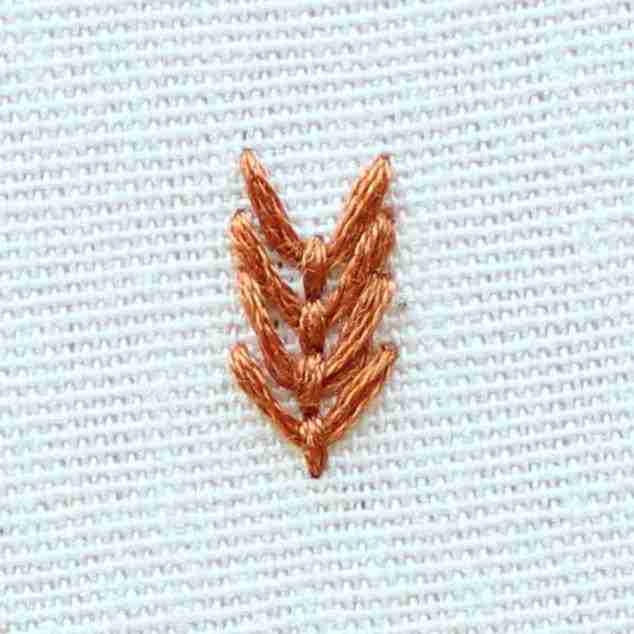
Fly Stitch
The fly stitch is a Y-shapeige embroidery stitch. You gebruikt hem for small blaadjes, aren, borders and loose accenten die licht and beweeglijk mogen ogen.
⚠ Common mistakes
- Trek de verankeringsstitch not te strak aan, anders verdwijnt de Y-shape.
- Houd de armen or de stitch ongeveer even lang als you a rustige rij wilt.
- Laat genoeg ruimte tussen de stitches als the luchtig must blijven.
Definition
Fly stitch is an embroidery stitch with two slanting arms that together form a V or Y shape. In the centre, you secure the loop with a short anchor stitch. This keeps the shape open and recognisable. The stitch is small, quick to learn and very versatile: a single fly stitch can be a leaf, while a row of repeated stitches forms a border, ear of grain or sprig. The length of the arms and anchor stitch determines how broad or slender the shape becomes.
When to use it
Use fly stitch for small leaves, blades of grass, ears of grain, sprigs, dot-like flowers and graceful borders. In a vertical row it can resemble an ear of wheat; in an arch it becomes a playful edging. The stitch works well for botanical motifs that do not need to be densely filled. You can also embroider it in different shades of green or with a contrasting anchor colour to add a subtle colour accent.
Practical tips
For a long row, first mark a faint centre line so that the anchor stitches line up neatly. Practise with short and long arms to discover which leaf size suits your pattern. Use a small embroidery hoop to keep the fabric flat. Work with one or two strands for fine sprigs and more strands for a clearer decorative border. Regularly view the work from a distance to check that the shape and rhythm remain even.
